Let the hand establish the scale
Pick up a jug before judging its profile. The handle opening determines whether your knuckles clear the body. The section of the grip influences pressure against your fingers. The distance between that grip and the filled vessel changes how much effort your wrist supplies. These are design decisions, even when a photograph makes them difficult to see.
Repeat the action with dry hands, then imagine reduced grip strength or limited finger movement. An apparently generous handle may still demand a pinching action. A polished finish may become slippery. There is no universal hand, so the useful observation is conditional: this shape supports this action for these users, under these circumstances. Good criticism names the circumstances instead of calling an object simply ergonomic.
Read the load through the joint
Alvar Aalto's bentwood furniture offers a useful starting point for discussing how a structural idea affects an object's character. The bent birch leg associated with Stool 60 redirects timber into a supporting geometry. Rather than treating the curve as decoration, ask what manufacturing process makes it possible and how the leg attaches beneath the seat.
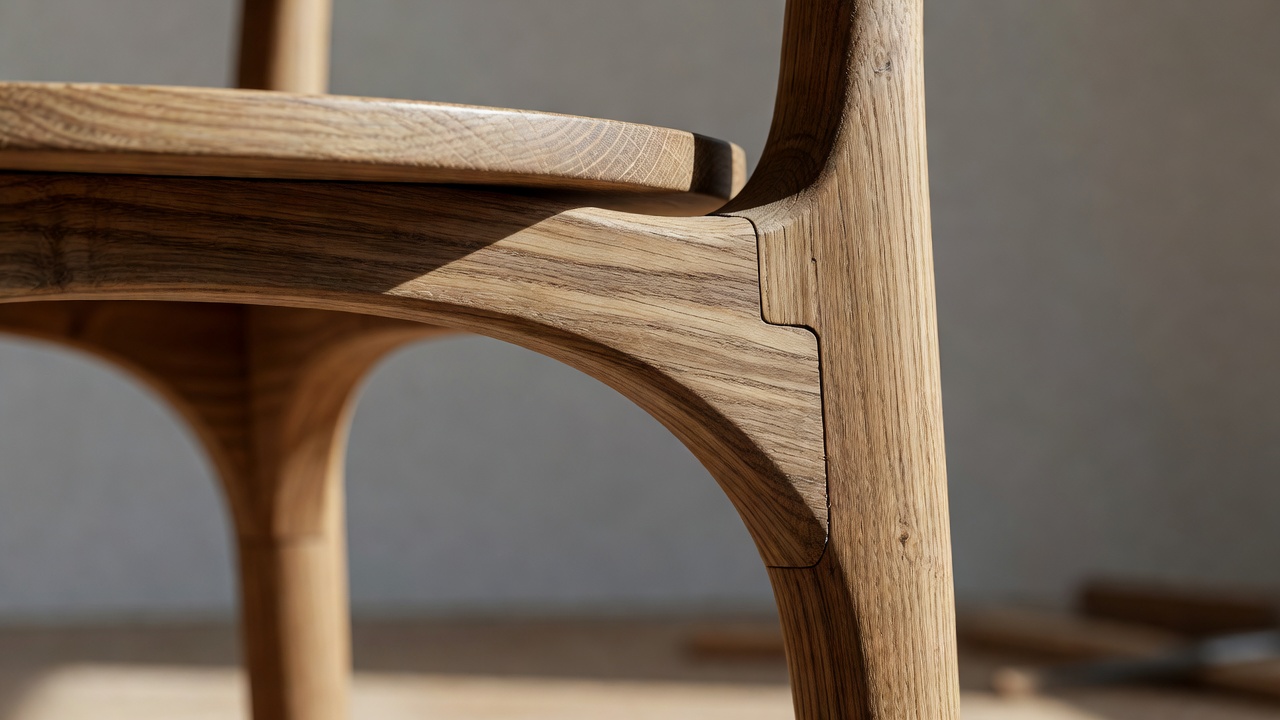
Hans J. Wegner's chairs invite a different reading: transitions between members can explain both craft and contact. A rail might be shaped for the back while also linking the frame. Neither example proves that concealed connections are better than exposed ones. Examine where forces travel, whether a connection can loosen, and whether maintenance requires access that the finished object actually provides.
Notice where geometry becomes instruction
A spout suggests a direction. A flattened patch suggests where to press. A widening base suggests stability, although the centre of mass and the surface underneath still matter. Objects communicate through these relationships before a user reads a manual. The message becomes stronger when form, motion and feedback agree.
Arne Jacobsen's work and the industrial products of Stelton can be useful reference points for examining controlled silhouettes, but a cylindrical outline is not an explanation in itself. Look at how a lid is lifted, how a vessel pours and how an interior can be cleaned. If a surface appears continuous, identify the seam that makes assembly possible. An object becomes more interesting when its neat appearance is tested against ordinary tasks.
Include sound, weight and recovery
An object's use has a sequence. It leaves a shelf, meets a hand, performs an action and returns to rest. A ceramic cup can feel comfortable when held yet strike a hard desk sharply. A small speaker can appear stable until its cable pulls it sideways. These moments are easy to miss when a study stops at the primary function.
Check recovery as carefully as operation. Can a lid be replaced one-handed? Does a cable settle without crossing a control? Does the object offer a safe resting position while wet? The question is not whether every sound or movement should disappear. Some feedback is valuable. A clear mechanical click can confirm engagement, while an unexplained rattle may suggest a loose component.
Write a dossier, not a verdict
Choose an object you already own and record three observed details. Describe what you can establish directly, such as a screw head, a soft foot or a sharp seam. Separate those observations from hypotheses about manufacturing or durability. Without a drawing or disassembly, a smooth joint does not reveal its internal construction.
Then record one successful action and one point of friction. This produces a more useful assessment than a score. Museums such as Designmuseum Danmark in Copenhagen and Design Museum Helsinki provide wider historical context, but a collection label cannot replace close observation. The aim is not to discover a single Nordic formula. It is to become more precise about why a particular object works, for whom, and where its compromises begin.