Observe a situation before inventing a solution
Begin with a routine: someone arrives at a desk, places a bag down and reaches for light. Notice what their hands are carrying, where the cable runs and whether the control is visible from the seated position. Ask permission before observing or recording people, and explain what the material will be used for.
Write observations separately from interpretations. “The person moved the lamp twice” is an observation. “The lamp is badly balanced” is a hypothesis that may have other explanations. Context could include glare, a shared desk or a temporary task. The Design Council's Double Diamond offers a useful framework for alternating exploration and focus, but no diagram replaces spending time with the actual setting.
Turn an ambition into a working brief
“Make a calm lamp” leaves almost every important question open. A working brief could instead propose a light that can be adjusted without searching behind the shade, occupies a defined desk area and can be maintained without destroying its enclosure. These are still intentions until suitable tests and engineering requirements are specified.
List constraints and unresolved assumptions. Who is expected to use the control? What tasks require illumination? Does portability matter? Must the light operate without a network? The illustrative lamp from our Minimal Tech study chooses local physical control, but that is a response to a brief rather than a universal rule. An interface for a shared building might have different coordination needs. Record why a choice was made so that later revisions can challenge the right assumption.
Build only enough to answer the next question
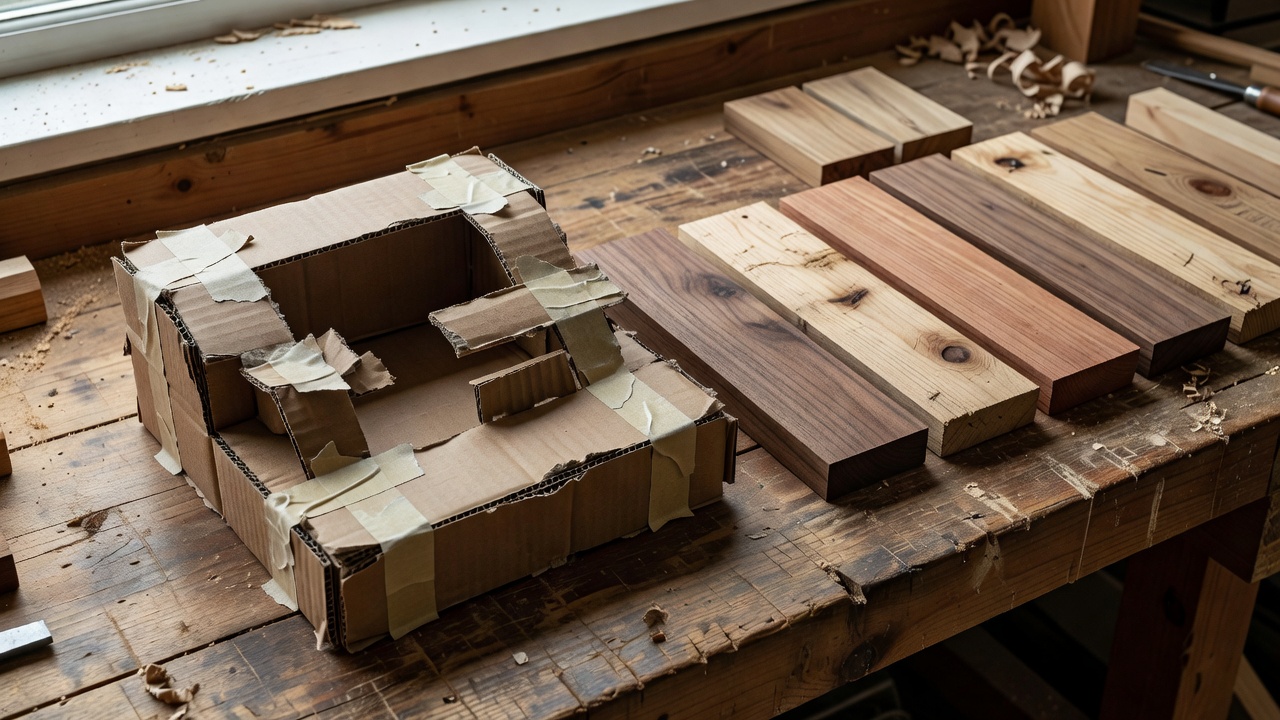
A cardboard base can reveal whether a control is within reach. A weighted mock-up can expose lifting and stability issues. A separate control rig can explore resistance and feedback without pretending the outer enclosure is finished. These models answer different questions, so they should not be treated as interchangeable evidence.
Keep early work low risk. Use unpowered models for spatial and handling studies; do not improvise mains-powered assemblies from an editorial description. Thermal, electrical and structural questions require appropriate expertise and controlled evaluation. A beautiful rendering establishes an intended appearance, not manufacturability. A functioning demonstration establishes some behaviour, not compliance. Label each artefact with what it can show and what remains unknown.
Watch actions, then revise the construction
Invite people who did not develop the concept to try realistic tasks. Ask them to locate the control, change the output and return the object to a resting state without coaching them through the intended path. Avoid turning a small informal session into a population-wide claim. Note the participants, context, limitations and recurring points of confusion.
Include maintenance as a task where it can be evaluated safely. Can the enclosure be opened with appropriate tools? Is the cable routed so that reassembly is clear? Does accessing one worn part require removing an unrelated fragile one? If a supposed improvement makes service harder, record the trade-off rather than hiding it. Revise the relevant feature and test again; changing several variables at once can make the result difficult to interpret.
Document what is resolved—and what is not
A useful dossier contains the brief, observations, model purpose, test conditions, revisions and open risks. It should distinguish intended materials from confirmed specifications and proposed repair steps from demonstrated ones. If a concept is unbuilt, say so. If a claim depends on supplier information, identify that dependency.
Victor Papanek's Design for the Real World and Donald Schön's The Reflective Practitioner offer different ways to think about responsibility and learning through practice. Neither supplies a shortcut from good intention to a verified product. Before production, a team must address sourcing, manufacturing tolerances, relevant safety requirements and quality control. The editorial lesson is smaller and immediately useful: every claim should point back to something observed, tested or clearly identified as an unresolved proposal.